What's On My Shelves?
This blog post is a sequel to my write-up on Shelfie. If you're interested in a closer look at my tabletop RPG collection, head there first! In this blog post, I'll be talking about the rest of my collection of books.

How would you describe your collection?
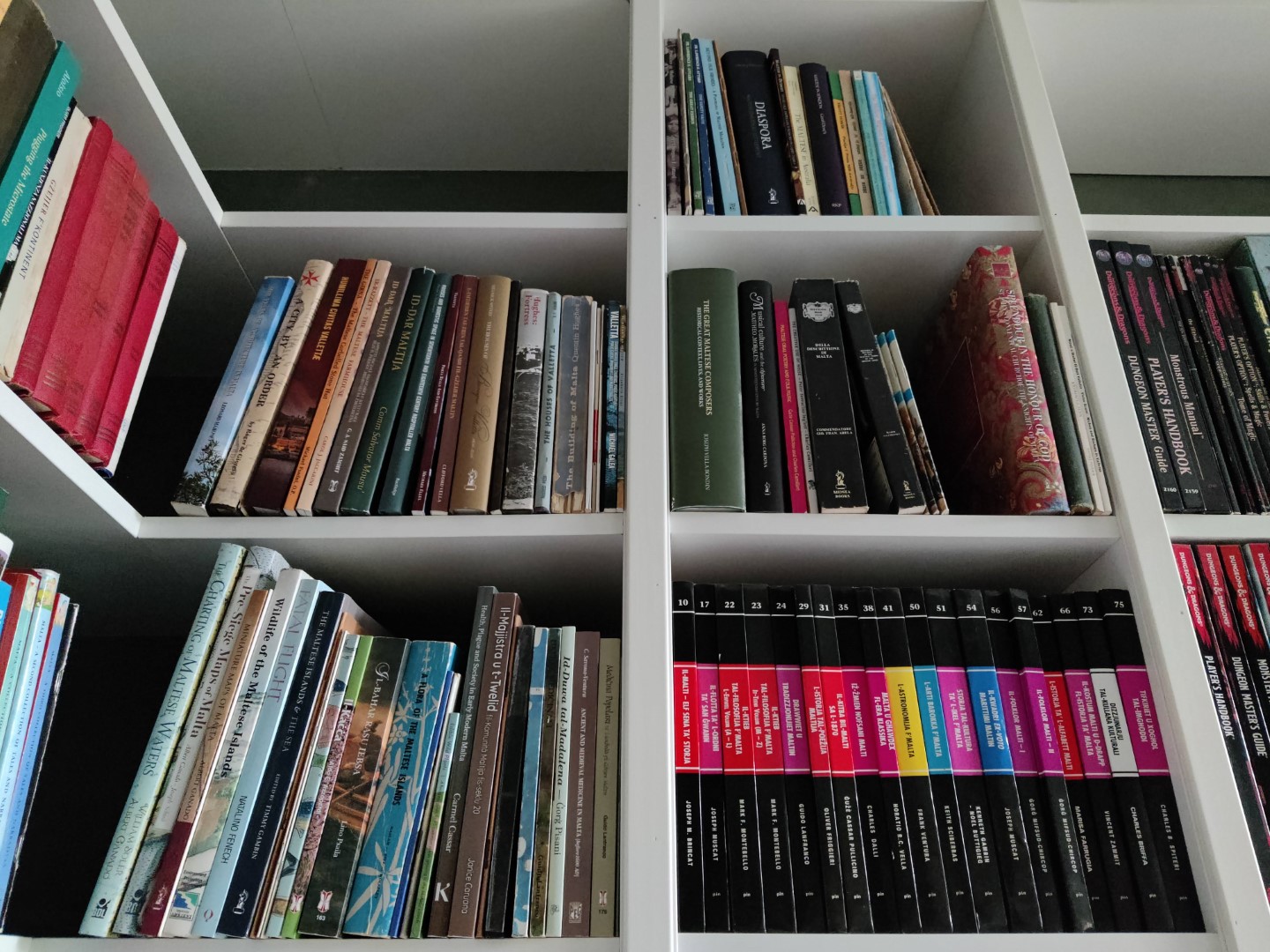
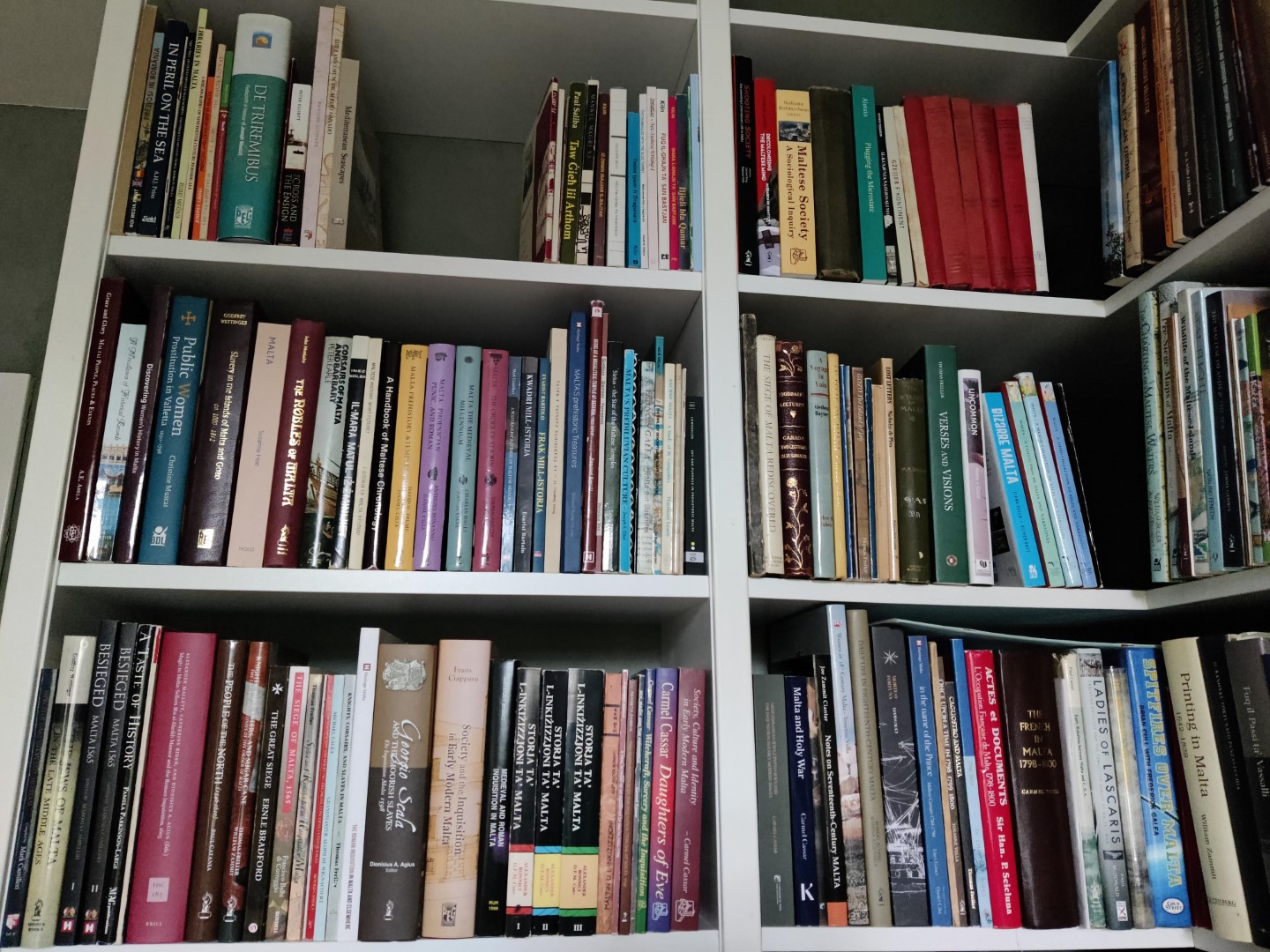
The vast majority of my collection of books can be categorised as Melitensia, books about Malta or published in Malta. After that, the second biggest batch are my tabletop RPGs, which I've talked about on Shelfie. The remaining categories in my collection are folklore and mythology, game design, and miscellanea (everything else that doesn't fit in either of the above categories).
The image above doesn't showcase my entire collection of books, since I still have quite a few books at my parents' house that I still haven't moved.
What are the languages that make up your collection?
Since I am Maltese, I am bilingual. I grew up with both English and Maltese, and consider them both to be my native language. English obviously represents the vast majority of my books, but a significant portion of my collection is in Maltese.
The other languages that are represented are Italian and French (both of which I've studied and can read). I then have a handful of books that are in a mixture of languages (normally English and another language that I normally cannot read), such as Latin, Arabic, German, Romanian, Swedish, Latvian, Welsh, and Scottish Gaelic.


How is your collection organised?
My Melitensia collection is divided into categories: folklore, history, language, regional history, emigration, dictionaries, art, architecture, etc. There's a sizeable chunk of the collection that's made up of oversized books that sit in their own section, since they wouldn't fit with any of the above categories! Most of the books here are ordered by height, but the history section is also ordered by time period to make things slightly easier to find. It's not a perfect system by any means, but I'm still figuring it out.
The rest of my books are grouped into loose categories, but don't really have any organisation beyond that.
How has your collection changed over time?
While I've always had Maltese books growing up, the drive to acquire more books in Maltese was due to The Maltese Bestiary, written by Stephan D. Mifsud and published in 2014 by Merlin Publishers. After reading it and being amazed by its contents, I wanted to learn more and thought the best way to do so was by trying to find some of the books mentioned in the bibliography section at the end of the book. That search ended up spiralling into my current collection (and I'm proud to say that I now own all 35 references cited at the back of that book)!

A large chunk of these books are second hand, but due to the small print runs and audience for Melitensia, I try and buy any newly published books if they're interesting to me and I can afford them.
With my folklore and mythology books, I'm normally on the lookout for any folktales or books about local folklore when I'm abroad or when I'm scouring charity shops. I do this because I think folk tales reveal a lot about the culture's interests and worries, and I'm also curious to see the similarities across vastly different people! I was inspired to collect folk tales by Zalka Csenge Virág, although I'm sure her collection is vastly superior to my own!
Finally, my game design collection is due to my academic background and my day job in game development.
What's your most prized item in your collection and why?
Given that most Maltese books have very small print runs, some of these books become highly in-demand and very difficult to find. Some of the books in my collection only got there because I came across them at the right time through sheer luck, or only appeared in estate sales, where I fought over them with others that were interested in buying them. Given that a few of these books were printed in especially limited print runs (such as 500 or 1000 copies), I'm super happy to count them as a part of my collection!

What's your favourite part of your collection of books?
Because a significant chunk of my collection is second-hand, I often encounter traces of the books previous owners. Some books are signed and dedicated, some contain ex libris plates from their former owners, some contains newspaper contains announcing the author's death, some contain funerary cards (santi), some are former library books that have been removed from their collection. Some books even contains letters of correspondence inside to and from the author! Each book seems to have a story to tell.


What's the oldest addition to your collection?
A possible contender is Manwel Magri's Ħrejjef Missirijietna, which my mum would have bought while I was growing up. For many years, it sat unassumingly on a shelf until I became interested in reading it and was told we already owned a copy.
What's the oldest book in your collection?
If unbound paper counts, the oldest object in my collection is a sheet of paper titled Inscription Athlantico-Phœnicienne trouvée à Médine, ancienne capitale de l'Isle de Malte l'a 1826, printed in 1829. This is a lithograph made to showcase the stone that was purported to be discovered by Fr. Galea in Mdina, and identified by Grognet de Vassé to be written in an Atlantean script. The stone was widely circulated throughout Europe and examined by academics and scholars, and deemed to be a forgery. This lithograph was a direct inspiration to my most recent game, Taħt il-Mewġ, a text adventure about Malta and the search for Atlantis.
Otherwise, if that doesn't count, the oldest book in my collection is Maturin M. Ballou's The Story of Malta, a travel/history book viewed through the eyes of an American. It was published in 1893 by Houghton, Mifflin and Co.

What's the newest addition to your collection?
One of the latest Maltese books that I've added to my collection is this massive tome titled The International Dictionary of Artists who Painted Malta, edited by Nicholas de Piro. I own the second edition of this book, published in 2002 by the Audio Visual Centre.
I've also recently picked up a copy of Reiner Knizia's Dice Games Properly Explained, which I bought after reading Skeleton Code Machine's newsletter entry about taking inspiration from soccer when designing tabletop RPGs, which itself was inspired by another one of Knizia's books on game design.
A while back, my mother-in-law gifted me the book Street Style: Art and Dress in the Time of Caravaggio, by Elizabeth Currie, published in 2025 by Reaktion Books. It's a historical look at the fashion in early modern Italy, and I'm hoping it'll influence a future project.

What's the newest book in your collection?
The newest Maltese book in my collection is probably Kwadri mill-Istorja, written by Evarist Bartolo and published in 2026 by Horizons Publications. Here, the author describes microstories throughout Maltese history that often go overlooked.
From my game studies collection, the newest book is The Game Narrative Kaleidoscope, edited by Jon Ingold and published in 2026 by inkle studios. It's a fascinating look at how different people approach narrative in games, and the accompanying podcast is great!
In folklore and mythology, the newest book is probably Fairies: A History, written by Francis Young and published in 2026 by Polity. I've increasingly become interested in faeries (perhaps for a future project?), so I can't wait to properly dig into this when I get the time.

Fiction vs Non-Fiction?
My physical collection leans very heavily towards non-fiction. There are a couple of reasons for this; first of all, my fiction collection is still at my parents' house, and second of all, I tend to prefer reading fiction on an ebook reader since it's way easier to carry around.
What book opened your eyes in some way, and how?
I've described how seminal The Maltese Bestiary is to my work as Għar Gremxul several times, both in this very post as well in my previous blog post where I discussed my personal Appendix N. I've also previously described how I was inspired by the book Il-Baħar Rasu Iebsa, written by Lino Psaila and published in 2003 by Klabb Kotba Maltin.
However, there are other books that have influenced me in a similar way. Jorge Luis Borges' The Book of Imaginary Beings , published in 2002 by Vintage, is one book that I've recommended to anybody around me who will listen because of how it's influenced me on multiple levels; the format of a bestiary with its innovative descriptions of creatures that may or may not exist are supported by citations to sources that may or may not exist! Before I realised this, I went down a rabbit hole trying to track down the original source of one particular creature.
There are so many other books and authors that I consider influential and that have shaped me and my work in some way! Perhaps a blog post for another time.
The one that got away?
I have a whole list of books that I'm looking for, some of which have been on my wishlist for a decade now! Most prominently are books from the Kullana Kulturali series, a multi-volume encyclopedia in Maltese. I once came across the opportunity to buy a complete set, but declined because of the price, but buying single volumes for inflated prices is arguably worse.
The most beautiful book in your collection?
I own a couple of books published by the Folio Society that are displayed elsewhere on a different set of bookshelves. Surprise! My wife gifted me a copy of Dante's The Divine Comedy, published in 2023 by The Folio Society, and the book is absolutely stunning.

Paperback vs hardback?
I always prefer hardback books if I can, though moving apartments has become an absolutely nightmare as a result. Turns out hardback books are really heavy!
I also have a few comics and a few zines, as well as few academic journals (but I guess all of those count as paperbacks).
How do you mark which page you're on? Do you use bookmarks?
Indeed I do! Here's a selection!

What's your digital collection like?
My digital collection consists of both non-fiction and fiction ebooks that I read on an extremely old Kindle Paperwhite, as well as academic PDFs that are related to Malta in some way that I find online from the local university or from academic institutions abroad. I also have a few audiobooks that I've listened to, but I've not kept up with this practice unfortunately.
I hope you enjoyed taking a tour of my bookshelves, both through my tabletop RPGs on Shelfie, as well as the rest of my shelves here! Feel free to reach out on social media if you have any comments or questions about my books; I'm more than happy to talk about them!